
What is community property? Is California a community property state? According to the Legal Assistance Department of the Department of the Navy, California's community property law can be defined as the legal method of characterizing the property interests acquired during marriage. In simple terms, this means that all assets and debts acquired during a marriage will be divided 50/50 between spouses when they file for a divorce or a legal separation in California.
Community property is actually a system of ownership that applies to married couples in some states, including California. The distinction between separate and community property doesn't matter until the couple divorces or one dies; at that point, the survivor can claim an equal share of both types of assets.
The Court divides the assets and debts it deems community property, which may include incomes, bank accounts, stocks, automobiles, and pensions. However, if a spouse claims that an asset or debt is not community property, they will have to present evidence accordingly. If the spouses fail to reach a voluntary agreement on a 50/50 split, the Court may intervene, or the matter may proceed to arbitration. Essentially, "for every dollar earned during marriage, each spouse owns half and may be able to dispose of the income without the other's consent." Let us understand what your rights are during property division in a divorce, as explained by our divorce attorneys at JOS Family Law.

Understanding California Family Code Sections 760 and 770
The California Family Code Section 760 states that all property, real or personal, wherever situated, acquired by a married person during the marriage is to be deemed community property except otherwise provided by statute. On the other hand, Family Code Section 770 states that separate property can be defined as
- 1. All property owned by the person before marriage
- 2. All property acquired by the person after marriage by gift, bequest, devise, or descent.
- 3. The rents, issues, and profits of the separate property.
- 4. Assets acquired after separation but before a divorce
- 5. Assets acquired after a judgment of legal separation if it does not include a provision awarding spousal support (such as child support) or division of assets (such as real estate).
Separate property is items such as cars, artworks, and investments purchased with money earned by just one spouse. In California, it's possible to own real estate together as joint tenants (both owners have a 50% stake) or tenants-in-common (each owner has their own percentage stake).
A tenancy-in-common is when two people don't want to put up half the price for a house, but they both want to live there. In these cases, they would agree on what percentage each owns.
What this means is that if one person starts their own business before they get married and makes money off that business, then that's their separate property. If someone inherits a house from their parents during the course of the marriage and doesn't live in it together, then that's also going to be considered their own separate property.
So if you buy something with your personal credit card while you're married, make sure that it is either given to both of you as joint tenants with the right of survivorship so that whoever survives will automatically own 100% of the asset.
Better yet, put all shared purchases on one bank account under both names so there can't be any confusion about what's shared property versus what's separate property. That way, neither partner can say - It was my money when in reality, it came from both people's pockets.
Furthermore, California Family Code Section 125 additionally defines "quasi community property" as any property, real or personal, wherever situated, acquired by either spouse while domiciled elsewhere, which would have been community property if the spouse who acquired the property had been domiciled in this state at the time of its acquisition. This simply means that if you were married in California but spent a part of your marriage outside the state, then any property acquired while you were living elsewhere will be deemed “quasi community property” and will be treated the same as community property.
The Impact of Marriage on Your Property
Once spouses marry, they accumulate community property together and share responsibility for all debts acquired during the marriage. This means that if a spouse is running a debt in their name alone, the other spouse may also be held accountable for it. The time period in which the debt was incurred is more important than the title under which the debt account was created. If you fail to pay your taxes or have proper withholding from pay before or during your marriage, the IRS or the California Franchise Tax Board may garnish your spouse's wages and accounts at financial institutions.
A common misconception about Community Property Rights is that it applies to all couples in a relationship, including those who are not married but living together with a common understanding of how financial decisions will be made and split between them.
However, this isn't true. In order for one person to claim rights under Community Property Rights, they must be legally married and comply with certain state requirements (such as filing taxes jointly).
The Impact of Divorce on Your Property
Under the provisions of Community Property Rights, spouses are entitled to 50% of each other's income, profits, or gains acquired during their marriage. Income includes money earned from wages, bonuses, commissions, overtime pay, retirement plans such as pensions or 401(k)s, interest, and dividends on investments such as stocks and bonds.
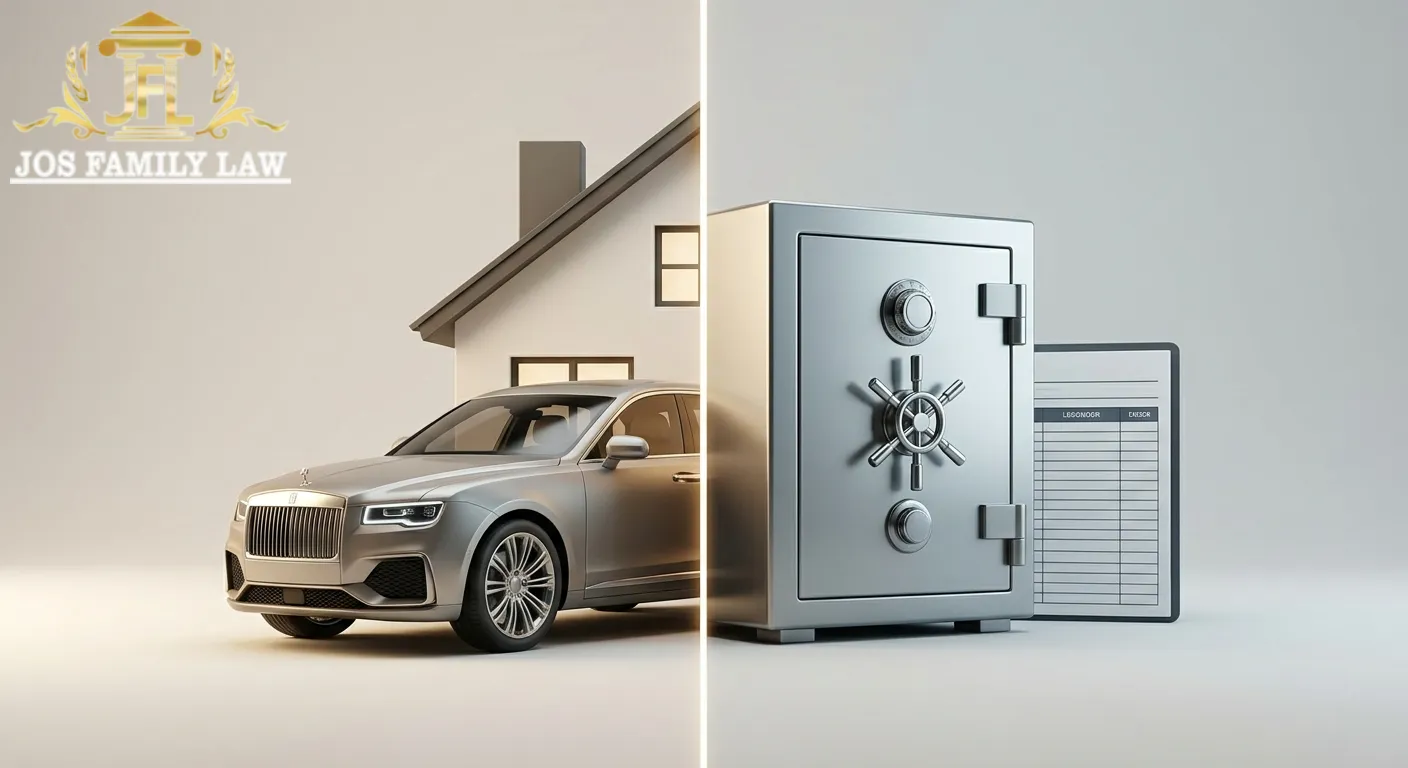
Profits include any increases in the value of assets that have taken place since being purchased. Gains refer to any assets acquired through inheritance, lottery winnings, gifts, divorce settlements, or the sale of real estate. The only exception is when an individual has gifted away his or her own share.
Since all community property is split 50/50 between spouses, the overall value of the marital property is assessed and thereafter divided equitably. California Courts can achieve this 50/50 split in the following ways:
- 1. Spouses can sell off the property and divide the profits between themselves.
- 2. Spouses can trade their assets between themselves until each acquires an equal value.
- 3. One spouse can pay the other a fair share of the community property.
Let us now understand how community property works based on a few examples.
Given below is the division of the community property of a couple married for 10 years. We will assume they are called Spouse 1 and Spouse 2 for convenience.
Automobiles:
Your Orange County divorce attorneys will look up the Kelley Blue Book or the private party value of the vehicles owned by each spouse. Let us assume that one spouse's car is valued at $15,000 with no debt. On the other hand, the other spouse's car is valued at $20,000 with a debt of $5,000. As a result, the net community interest of the latter spouse will be ($20,000-$5,000) $15,000. Even if both spouses have their respective vehicles in their name, they still own 50% of each other's car. This also means that Spouse 1 owns 50% of Spouse 2's car debt. Ultimately, the Net Community Interest of both cars will result in ($15,000+$15,000) $30,000.
Bank Accounts:
Let us assume that both spouses have a joint bank account in their names with a net worth of $20,000. Since the money in the joint account was earned during marriage, the community has an interest of $20,000. However, Spouse 2's account has funds that they received from an inheritance. Remember that Family Code Section 770 states that all property acquired by gift, bequest, devise, and descent shall be deemed separate property. So, even if Spouse 2 received their inheritance during marriage, Spouse 1 cannot claim any share in it, and the inheritance will be treated as separate property.
Businesses
Spouse 2 started a baking business during their marriage with a bank loan in both spouses names, which was paid off before the divorce. While Spouse 2 thinks the business is worthless, Spouse 1 opines that it must be worth something. Both spouses retain an expert under Evidence Code Section 730 to provide a fair and unbiased estimate of the value of the business. The expert calculates the value to stand at $40,000. Both spouses agree with the expert's recommendation, and this value is presented to the Court.
401(K)
Spouse 1 provides their most recent quarterly 401(K) statement, which stands at $210,000. Spouse 1 had begun contributing to their 401(K) fund five (5) years before the marriage. This triggers the separate property presumption, as any property acquired before marriage is deemed separate property. Here, Spouse 1's 401(K) will be treated as a mixture of separate and community properties and the division will be in the proportion of the separate and community interests.
Therefore, the community interest in the 401(K) will be 2/3 of its value since the parties were married for 10 years, out of which Spouse 1's contributions lasted for 15 years. Spouse 1 will receive 1/3 of their separate property since they contributed to it 5 years before marriage. The community has an interest of $140,000, while Spouse 1's separate property interest will stand at $70,000.
Credit Card Loans
Spouse 1 has accumulated a credit card debt of $3,000 during the marriage, requiring both spouses to pay 50% of the debt.
Student Loans
The treatment of student loans differs from that of other loans obtained during a marriage. Family Code Section 2641 states that the spouse who takes out loans for their training or education is the one who must repay them. There is an exception to this rule, though, if the loan was taken out more than ten years before the divorce filing and the marriage benefits greatly from it. Remember that at the start of their marriage, Spouse 2 had taken out a student loan for their baking degree, which contributed to their $40,000 baking business. Under such circumstances, Spouse 1 will have to pay back the loans. Nevertheless, Spouse 2 also possessed a degree in Modern World History, which was obtained during the marriage and did not help the community. The $50,000 remaining on their Modern World History debt will therefore be entirely Spouse 2's responsibility.
Family Pets
There are two ways in which the court can handle a situation where both parties want to keep the family pet(s):
- 1. The Court can ask whether the family pet was a gift to one of the spouses. If this is the case, then the pet will be considered separate property confirmed to a spouse.
- 2. The psychological attachment each spouse has to the pet.
Through the examples presented above, you must have gained a broad idea of how community property is divided during a divorce. California law grants a broad freedom of contract to give you and your spouse a great deal of flexibility in deciding how to share your assets. Trial courts have considerable power to decide how to divide a community property in order to achieve a net equal distribution where the parties are unable to reach an agreement.
How Is Debt Divided In California?
As you know, California is a community property state, which means that all income acquired during the marriage, regardless of who earned it, is equally owned by both spouses. The only exceptions are if one spouse used their individual funds to purchase a major asset (such as a home) or if the couple agrees otherwise in writing.
In other words, there's no such thing as separate property in California. What this means for you - You will have to share any debt incurred during your marriage. If you file separately, not only will you be on the hook for paying back what each of you owes, but also for any additional debts your spouse incurs after filing for divorce.
Plus, creditors may be able to pursue either party based on outstanding debts from before or after the separation date. If you want to avoid those headaches, consider waiting until after divorce proceedings are finalized before making major purchases with credit cards or taking out loans.
Agreements and Spousal Support Benefits
If you and your spouse can agree on the boundaries of community property, your Orange County family lawyer will draft a Marital Settlement Agreement. The spousal support issue may be impacted by how assets and debts are distributed. If Spouse 1 is required to pay Spouse 2 spousal support, the parties are free to make agreements such as "spousal support buyout" to substantially offset any equalization payment that could be required.
The Court's Discretion in Community Property Division

While California's community property laws advocate for an equitable 50/50 split, the judges can order an unequal distribution to account for fundamental differences between spouses, when making their divorce rulings. The scenarios which may warrant an unequal distribution of the property can include:
- One of the spouses has a lower earning potential due to a lack of relevant skills, education, or training.
- One spouse is highly advanced in age.
- One spouse has chronic health concerns.
- One of the spouses dedicated their entire married life towards domestic responsibilities and taking care of the children.
- One spouse wasted their community assets.
- The longer the marriage, the more complicated the financial situation, necessitating a split.
- The marriage was abusive toward one spouse. In such a case, the judge can give a higher portion of the community property to the victim as compensation.
- A prenuptial agreement was notarized and signed by the couple, allowing them to define property division on their terms. Prenuptial agreements can differentiate separate property from community property and specify asset division during a divorce.
Legal Considerations in Community Property Disputes
Documentation and record-keeping are essential in community property issues. Couples ought to keep meticulous documentation of all assets and liabilities. This assists in identifying community property from separate property. In the event of disagreements, courts utilize these records to render fair judgments.
Retaining an attorney can offer crucial counsel. Attorneys assist couples in understanding their rights and maneuvering through the intricacies of community property law. They can also aid in the formulation of premarital agreements and represent you fairly in a divorce processes.
By acknowledging the differences between community and separate property, spouses can reduce disputes. Understanding the effects of marriage and divorce on property ownership enhances communication and trust between couples. Ultimately, utilizing legal instruments guarantees fair asset allocation. With adequate preparation and understanding, couples may adeptly navigate California's community property framework.
Frequently Asked Questions
1. What qualifies as community property in California?
In California, most of the things you own and owe during a marriage or registered domestic partnership are considered community property. This includes income, real estate, cars, and investments for retirement. No matter which spouse made the money or whose name is on the title, both people usually have an equal share.
2. How is community property divided during a divorce?
California law requires an equitable distribution of the marital estate, mandating a "50/50" split of its total value. This does not necessarily require the liquidation of all assets; instead, the court may assign certain properties to one spouse while compensating the other with alternative assets or an "equalization payment."
3. What is considered separate property?
Separate property includes assets acquired before marriage or after the formal separation date. Furthermore, inheritances or specific gifts acquired only by one spouse during the marriage are generally exempt from the 50/50 divide, provided they were not "commingled" with joint assets or communal accounts.
4. What happens to debts acquired during the marriage?
Debts are regarded in a manner analogous to assets. Balances on credit cards, mortgages, or loans incurred between the date of marriage and the date of separation are often divided equally. Both spouses are generally liable for fifty percent of the entire debt, regardless of whether only one spouse's name appears on the account.
5. Can we agree to a different division?
While California law mandates an equitable distribution, couples may negotiate their own agreement through mediation or settlement. If the agreement is fair and both parties readily acquiesce, the court will usually approve a tailored distribution that diverges from the standard 50/50 legal requirement.
Why Contact JOS Family Law?

Community property laws are complex, but they can have a major impact on how assets are distributed in the event of a divorce -or- death. As you plan ahead, consider consulting an attorney to discuss how the laws might affect your family situation. Doing so now may save you a lot of heartache down the road. Here are a few vital & essential things to consider:
- Consult an attorney now about community property laws.
- Plan for what happens if your partner dies before you.
- Consider how the laws will apply if one partner's income is higher than the other's.
- Plan for what happens if one partner decides to leave their job and start a new business.
- Consider whether it makes sense to keep a joint checking account when one partner earns more than the other.
- Determine how much housework each person is responsible for.
- Keep separate financial accounts, as this will prevent one spouse from depleting funds that should be spent on household expenses.
Be aware of any marital settlement agreements that were signed during the marriage.
Conclusion
Dealing with California's community property laws can feel like a balancing act. The judgment can either swing from a standard 50/50 split, on one hand, to navigating the complexities of mixed property, on the other. Whatever your unique situation may be, you must always remember that California's courts abide by one simple law all community property must be divided equitably between the spouses. The choices you make during the division process, such as opting for a "spousal support buyout" or negotiating a Marital Settlement Agreement, can have a long-lasting impact on your financial stability for years to come.
At JOS Family Law, our property division attorneys are dedicated to your rights, such that your finances and future are secured. While California's community property laws provide the framework, our experienced divorce and family law attorneys provide the strategies and compassionate guidance you need to ensure that your rights and peace of mind are taken care of. Call us today at (714) 733-7066 to get started.
Jos Family Law
Categories
Get In Touch
Our attorneys are here to help you during every stage of your case. Schedule a confidential consultation and know your options with the seasoned counsel of top family law attorneys.
Contact Information
Please call, email, or contact our office online to arrange an appointment for your case today.
Get In Touch
Our attorneys are here to help you during every stage of your case. Schedule a confidential consultation and know your options with the seasoned counsel of top family law attorneys.
Contact Information
Please call, email, or contact our office online to arrange an appointment for your case today.
Google Reviews
4.7 (175)


Sonia Fernández
Jos exhibits exceptional compassion and understanding, promptly addressing all inquiries to facilitate clarity and calm throughout the process with comprehensive and sincere explanations. He offers potential solutions to minimize unnecessary court costs. His team operates efficiently and effectively to complete the task. I highly recommend this law firm as it operates with integrity.
....Read More
Carlos Serrano
Thank you very much to Mr. Jos and to all his group of professionals who helped me get out of my child support case with a very good result. Each case is different and my case was very complicated. I live in the state of Virginia and the child support office of the state of California was starting a case against me, the amount they wanted me to pay was ridiculously high I didn't know what to do because I don't live in California and I had never met the child either. I searched online for a lawyer in California and thank God I found Mr. Jos's law office. I don't know them personally but I put my trust in them and they didn't disappoint me. We had very good communication despite the distance and they were always available to talk to me and clarify my doubts. Mr. James was the one who took my case to the end and after a long and very difficult process everything went very well in my favor much more than expected. I am very grateful to God for putting the entire team of professionals from Mr. Jos' office on my way. Words are not enough for me to describe everything they did for me and how grateful I am. I definitely recommend Mr. Jos's law firm. Thank you Mr. James for not giving up in my case and having achieved a magnificent result in my favor.
....Read More
Alexandra Duvall
Jos Family Law has been absolutely fantastic in helping me through my child custody case. Mr Jos communicated with me throughout the entire process. He was very empathetic and understanding with my case and my concerns. The team was always supportive and never once did I feel like they didn’t take my case seriously. I’m so grateful I chose this law firm to represent me and I would 100% recommend this team to anyone seeking assistance. In the end I received the outcome I was looking for which was Sole Physical Custody. Thank you so much Jos Family for representing me.
....Read More
Marco Galatro
This was the second attorney that represented me for my divorce. Binoye is a very knowledgeable, fair, and professional attorney. They are reliable and this made my experience way less painful. They are definitely not greedy for money, they are not one of the many attorneys out there who overbill for their services. I truly recommend them.
....Read More
Roya
Mr. Jos is by far the best attorney l've ever had to work with. He is diligent, extremely prepared and informed and patient with his clients and goes above and beyond the call of duty to make sure you get the results you are hoping for. I recommend him to anyone who needs a Family attorney.
....Read More
Ricardo Lajaruna
My most sincere gratitude to the attorney Mr. James Sowers, who is very knowledgeable about the law, works with and for his clients. He is very transparent, honest and I am very grateful for his great support. His legal representation is highly recommended!!!
....Read More
Nader Zayid
JOS family Law took on my case which entailed custody and move away components and I honestly could not say enough great things about JOS Family Law! Mr. Jos is not only extremely knowledgeable and professional, but it is also extremely obvious how much he cares for his clients on a personal level as well. There is an expression that two heads are better than one, however, Mr. Jos' philosophy takes it further as eight heads are better than two. It was so impressive and reassuring how collaborative everyone at the office works together to meet on regular cadences and discuss their client's cases to brainstorm strategies in order to seek the best possible outcome for their clients. Mr. Jos has an amazing team of extremely talented and knowledgeable attorneys that have worked together on my case. James was the lead attorney on my case and also represented me in my hearing. James was able to get us everything we were asking for as he successfully proved that full custody remaining with me is in the best interest of the children and that the move away is in the best interest of the children as well. We were able to come up with a plan to ensure that the children's mother can visit regularly and still maintain a healthy relationship. James is a rock star attorney! I would without hesitation refer anyone seeking help in a family law matter to call Jos Family Law!
....Read More